
Beyond “Working the Vagus”
An Integrated View of the Nervous System, Trauma, and the Extraordinary Vessels

In recent years, ideas from Polyvagal Theory have become widely used in trauma-informed bodywork.
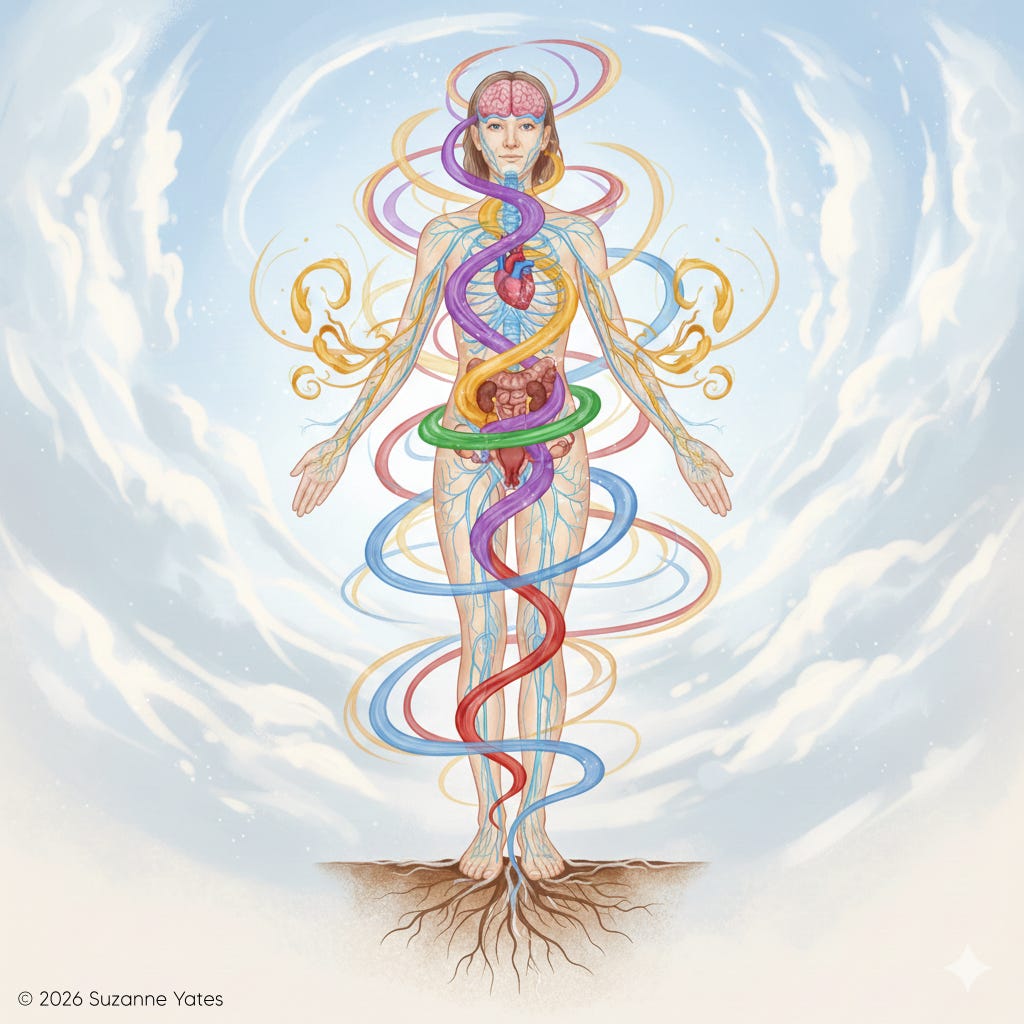
Many people, including myself, have found this framework helpful. It gave language to what we were already noticing in ourselves and in our clients: patterns of mobilisation, shutdown, and social engagement, and how these shape our capacity to relate, function, and feel safe.
There have always been critics of Polyvagal Theory, but recent research (2026 Grossman et al) has questioned some of its anatomical claims more thoroughly. As a result, many practitioners are now rethinking their work.
What is really being challenged, however, is the overly simplistic popular version of polyvagal theory: the idea that we could somehow “reset” the vagus nerve through touch at the base of the skull — as if we could directly access a nerve that lies deep within the brainstem and chest.
Most of us who work holistically never used Polyvagal Theory in this way. It was never a technique. It was a framework that helped explain why what we were already doing worked. It helped make sense of the power of touch, breath, rhythm, relationship, and presence. What touch changes is not the nerve itself, but the brain’s reading of safety, relationship, and context.
Polyvagal theory supported approaches that emphasise:
Creating physical, emotional, and relational safety
Respecting boundaries, choice, and consent
Understanding patterns of mobilisation and shutdown
Working with present-moment resources
Avoiding re-enactment and power imbalance
For me, the most powerful and direct way of doing this has always been through working with the Extraordinary Vessels of Traditional Chinese Medicine. These vessels regulate patterns across systems. They are not “equivalent” to nerves, but they coordinate development, integrate brain and body, hold early imprinting, and support reorganisation after disruption.
We can learn over time to re-tune our responses. As a child, I didn’t feel safe (my mother was bi-polar) and I think this is why I discovered the Extraordinary Vessels. The most powerful Vessels for re-setting in the current moment are the Stepping (or Motility, Orientation) Vessels. In my social media I share simple points and connections for these Vessels, which you can use in challenging situations. I use these often myself. A lovely practice which includes these Vessels and helps retune our body is to reconnect with the play and wonder of a child who feels safe and is open to explore.
What Polyvagal Theory Offered
In the early 1990s, Stephen Porges developed Polyvagal Theory as a new way of understanding the autonomic nervous system. Before his work, stress responses were mainly described as fight or flight (sympathetic activation: Yang) or freeze (parasympathetic withdrawal: Yin).
Porges added a third dimension: social engagement — a system that supports connection, curiosity, and co-regulation. He linked this to the vagus nerve, which is part of the parasympathetic system.
He highlighted several important ideas.
We are biologically wired for connection. Drawing on attachment theory and research into co-regulation, he described how safety is created through relationship and that our first year is crucial in setting our sense of safety.
He showed that our bodies shift automatically between states of safety, mobilisation, withdrawal, and collapse. These shifts are not choices. They are survival responses.
He helped move trauma-informed practice away from blame and “fixing,” and toward understanding how patterns are held in the body.
This was extremely valuable.
What Is Now Being Questioned
Current critiques focus mainly on two areas.
Anatomy
The idea that there are two clearly separate vagal systems — one responsible for safety and one for shutdown — is now seen as oversimplified. Nervous system states arise from multiple interacting pathways involving the brainstem, limbic system, cortex, hormones, and autonomic branches.
No single nerve operates in isolation.
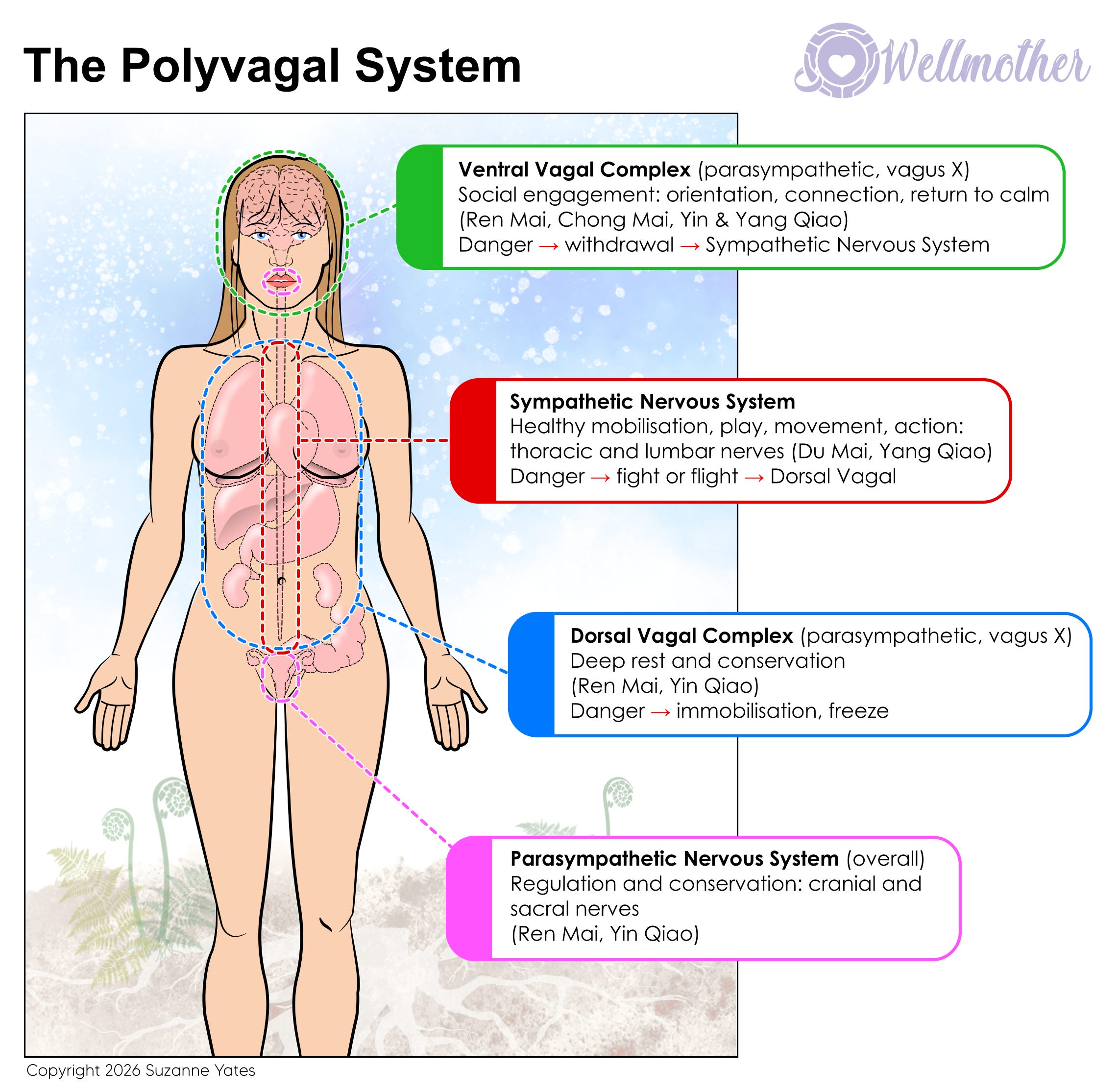
I had created a chart for my teaching, to explain this and link it with the Extraordinary Vessel which I need to update. I tried to for this blog, but it is quite complex. Still working out the best way to do this. Any ideas welcome! I think using overlapping circles and not emphasising the separation between the ventral and dorsal part of the nerve. This fits very much with Yin and Yang in TCM. They co-exist and shift. In my work, I always sense the shifts between Yin and Yang and tend to work the Extraordinary Vessels as Yin and Yang pairs.
Heart Rate Variability
Heart rate variability (HRV) was used as a marker of vagal tone. We now know that HRV reflects many systems: breathing, hormones, fitness, emotional history, and stress patterns. It cannot be reduced to emotional regulation alone.
As bodyworkers and TCM practitioners, we sense these changes in more subtle ways than numbers on screens. These include pulses, Heart and other organ rhythms, muscle tone, pathways and points along meridians. Regulation is a living, relational process.
A More Integrated Understanding of Regulation
Contemporary neuroscience increasingly understands regulation as the product of interacting networks rather than a single control system. Many layers work together continuously.
Note: I am not a neuroscientist, so please, if anything is incorrect, do let me know! Our bodies are complex! My work is about feeling the body in the moment and its memories. However I think it is worth trying to explain this because understanding informs our work.
Our Emotional Brain and Thinking Brain
Our brain develops in layers from bottom to top: brainstem, limbic system, and neocortex.
The most ancient part, the brainstem is well developed at birth. It governs breathing, heart rate, sleep, hunger, temperature, and elimination. Together with the hypothalamus, it regulates homeostasis, hormones, and immunity.
Above it lies the limbic system, our ‘mammalian brain’ shaped through relationship. This includes the amygdala and hippocampus.
If a child feels safe and loved, this system supports play, exploration, and learning. If a child feels frightened, abandoned, or unsupported, it becomes organised around fear and vigilance. This is important, because early imprints mark our system deeply. Trauma in childhood wires our system more towards expecting danger.
Sensory information passes through the thalamus to the amygdala. When threat is perceived, it activates the hypothalamus and initiates the release of stress hormones, preparing our body for fight or flight.
The hippocampus links experience to memory and context helping to distinguish past from present. Under chronic stress, cortisol disrupts this process. Memories lose their time stamp. Trauma is relived rather than remembered.
These systems act before conscious thought is possible.
The top part of our brain, the neocortex develops last, maturing through childhood, adolescence and early adulthood. It includes the prefrontal cortex which enables language, reflection, empathy, and imagination. It helps us say, “I am safe now.”
Under threat, sensory information from the thalamus passes up to here, allowing us to assess an appropriate response. If there has been trauma, its functioning can become disrupted. Communication between the limbic system and the prefrontal cortex breaks down. Perception can become fragmented and awareness of time collapses.
Body Awareness and Interoception
Regulation also depends on how well we sense ourselves from within. This is called interoception. It is processed through the insula and anterior cingulate cortex. These areas integrate bodily sensation, emotion, and meaning. The insula, folded deep inside the brain, integrates signals from the heart, lungs, gut, muscles, and skin. It creates our internal “felt sense.” The anterior cingulate cortex sits between emotional and cognitive regions. It links feeling with meaning, supports motivation, and processes social pain.
Together, these centres connect bodily sensation, emotion, and awareness. They are central to embodied presence. When they are underdeveloped or dysregulated, people may feel numb, disconnected, or overwhelmed.
Our Autonomic System (Yang and Yin)
The autonomic nervous system continuously adjusts our physiology in response to internal and external cues. It shapes posture, muscle tone, breathing, and heart rhythm, often below conscious awareness. Sympathetic (Yang) is more about how we mobilise, not only to danger “fight or flight” but in healthy activities of action and play. Parasympathetic (Yin) is not only about “freeze” and “shutdown”. If there is no threat it is about how we connect, rest, and digest.
These two systems blend and adapt. They do not simply switch on and off. Freeze and dissociation involve emotional, hormonal, and cortical changes together. This resembles the relationship between the Conception and Governing Vessels of Traditional Chinese Medicine: we are always shifting between Yin or Yang.
If the body has entered shutdown, it often needs to release trapped mobilisation before returning to connection. Movement, gentle shaking, and embodied expression can support this process in adults. It’s also important to understand the role of co-regulation. This is how nervous systems synchronise through shared rhythm, presence, and attunement. When someone feels held in another’s regulated state, their own system can soften. Hence the importance of relationship.
The Different Faces of “Overwhelm”
Many people describe themselves as “overwhelmed,” but this word covers very different nervous system states.
Some people are overwhelmed because everything feels urgent. Their mind is full, their body is tense, and they cannot stop thinking. This is a form of mobilisation: the system is in fight or flight, trying to cope by doing more.
Others are overwhelmed in a quieter way. They feel foggy, heavy, or unable to begin. They may withdraw, procrastinate, or disconnect. This is closer to freeze or shutdown. The body has decided that there is too much and has pulled back. However, for some people there may be lots of unexpressed emotions like anger which are bubbling away inside so freeze can include mobilisation.
Other people become overwhelmed through relationship. They stay engaged, helpful, and responsive to everyone else’s needs, even when they are exhausted. This “tend and befriend” response is closely linked to social engagement. It looks functional, but often comes at the cost of self-connection and boundaries.
Most of us move between these states. We may push for a long time in mobilisation, then collapse into shutdown. Or we may stay socially engaged while quietly burning out. Understanding these patterns is more helpful than trying to “calm the vagus nerve.” It allows us to respond to what is actually happening in the body and mind in that moment.
I have created a video on recognising these different states and understanding how to shift between them.
It should go up on my YouTube channel next Monday: but if you subscribe you can check. Meanwhile here is a video on how you can do an overall body release on yourself.
The Stress Hormone System: HPA Axis
Alongside the autonomic system operates the HPA axis: hypothalamus, pituitary, and adrenal glands. Short-term cortisol supports survival. Chronic cortisol leads to exhaustion, burnout, and immune disruption. Many people who appear “shut down” are not calm. They are depleted. In Chinese Medicine this usually corresponds to Kidney depletion. In TCM the adrenals are included within the Kidneys. The Extraordinary Vessels have a close relationship to these systems and working with them we can support Kidney depletion. Polyvagal Theory did not fully address this hormonal dimension.
Pregnancy, Early Life, and Regulation
My understanding of regulation did not begin with theory. It began through my work with pregnancy, birth, and early postnatal life. Working with babies and mothers — and reflecting on my own early life — showed me how profoundly the first year shapes stress responses.
Safety is learned through relationship. The body remembers before the mind understands. In early life, regulation happens through touch, voice, rhythm, smell, eye contact, and presence. Through thousands of repetitions, babies internalise what calm feels like.
This shows how important it is to support mothers and babies. Sadly our society does not give enough value and recognition to this core time. I am saddened by the myths that still abound regarding receiving bodywork during this time. Safe touch is one of the foundations of supporting healthy regulation: safe touch, enabling mothers and babies bodies to adapt.
If you want to study with me, if you are a massage or shiatsu therapist, I have a powerful retreat course this May near Glastonbury in the UK.
Discovering the Extraordinary Vessels
Traditional Chinese Medicine gave me a language that matched this lived reality: the Extraordinary Vessels. They predate organ systems. They govern development, transitions, identity, and embodiment. They integrate body, mind, and life history.
They correspond closely to:
Neural networks
Developmental pathways
Emotional memory
Attachment patterns
Through Ren, Du, Chong, Dai, Qiao, and Wei, we access brainstem, limbic, cortical, hormonal, and developmental systems. Their main organs include the Brain, Kidneys (and adrenal system), Heart and Reproductive Organs, Blood. They are the network which underlies and regulates all systems. They support reorganisation rather than fixing symptoms. They include regulating:
Mobilisation and rest
Safety and boundaries
Trauma integration
Reconnection after dissociation
Life transitions
Why Shiatsu and Bodywork matter
Many people today live disconnected from their bodies, overstimulated, under-supported, and separated from natural rhythms. We need practices that restore sensation, presence, relationship, meaning, and belonging. Polyvagal Theory opened an important door. It helped people recognise that their responses were protective, not pathological. Now we can integrate it into a richer framework.
As my main shiatsu teacher, Sonia Moriceau, always told us:
“Theory follows experience.”
Not the other way around.
Regulation is not something we do to the nervous system. It is something that emerges when we feel safe enough to be fully alive.
I’d love to hear what you think and also if anything is incorrect do let me know!
References:
The 2026 Study
Grossman, P., Ackland, G.L., Allen, A.M., Berntson, G.G., et al. (2026). Why the polyvagal theory is untenable: An international expert evaluation of the polyvagal theory and commentary upon Porges, S.W. (2025). Clinical Neuropsychiatry, 23(1), 100-112. https://doi.org/10.36131/cnfioritieditore20260110
Bessel van der Kolk: The Body Keeps the Score: You probably know this book, but if you don’t it is a classic book on trauma by a medical doctor who values the power of bodywork.
Dear Suzanne, thank you for writing this post. I really think that you touched many important points. We always look for easy answers but they don't exist and if they do they don't work. Life is too complex! I also think that the polyvagal theory was important contribution to the discourse and was an attempt to get a better understanding of patterns we can observe. It's a better understanding of the dynamics that lead to the ability to be able to accompany somebody on high sea. We don't need formulas, we need useful strategies. In the end it's always the achievement of the individual system to reorganize itself, but it makes a huge difference what kind of support it gets on this challenge.
Your work you are sharing with us contributes a lot in this quest. Trying to understand the situation and seeing the bigger picture can be very helpful! The work with the extraordinary vessels and getting to know the theory behind them I experienced as a very interesting and potent approach. And if we are lucky this work can be the drop to balance the boat in a way so it can keep on sailing.